

Recent professional learning engagements have prompted me to pay closer attention to the words and expressions I use. I have become increasingly aware of how easily I can unintentionally exclude people—not because of my intentions, but because of the language I assume everyone understands.
How often do any of us assume that everyone understands the language we use?
In my earlier work, I introduced the acronym TWIPS—terms, words, idioms, and phrases—to describe the language we use to communicate meaning (Zacarian, 2011) and later explored the concept in greater detail (Zacarian, 2013). Identifying TWIPS helps us recognize expressions that may not be readily understood and either replace them with clearer language or explain their meaning, making communication more accessible and inclusive.
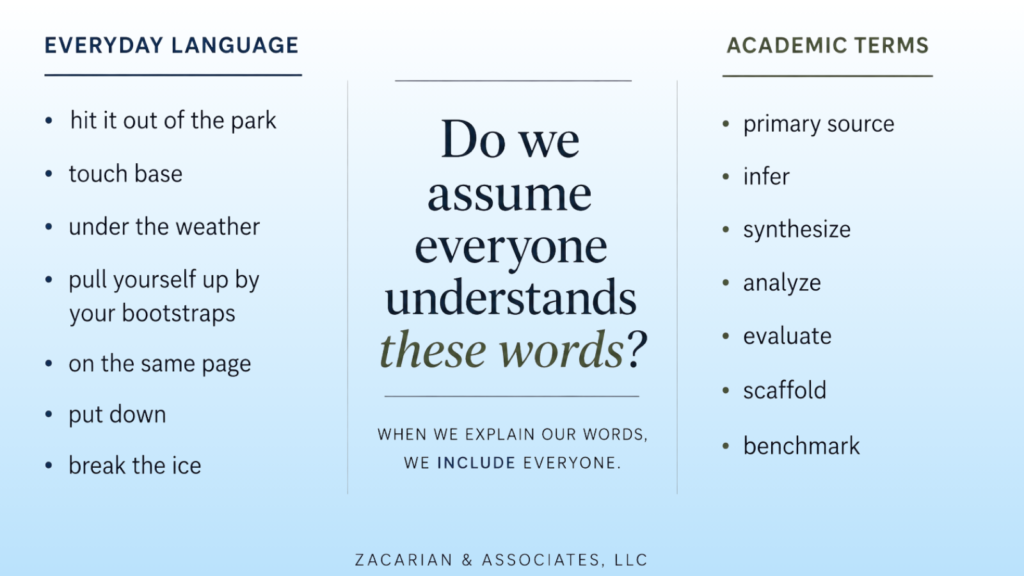
Consider the phrase, “You hit it out of the park.” A teacher says this to the whole class after students complete a collaborative task. In response, many students congratulate each other while others are unsure what the teacher meant. What caused the confusion for some but not all of the students? “Hit it out of the park” comes from baseball, where it refers to hitting a home run. Today it is commonly used to mean someone did exceptionally well. But not everyone grew up watching baseball or lives where baseball is widely played, making the expression far less transparent than many speakers realize.
Even everyday classroom directions can contain unfamiliar academic terms and idiomatic expressions that educators may not realize require explanation. Consider the following assignment:
As you read the primary source, put down three reasons the colonists objected to British taxes.
Some students may struggle to understand the academic term “primary source” (something created at the time of an event, such as a diary, letter, or document) and the idiomatic expression “put down,” which has multiple meanings, including to place something on a surface, criticize someone, euthanize an animal, suppress a rebellion, or write something. Rather than risk embarrassment by asking for a definition or clarification, some students may quietly withdraw from the activity. Confusion about the meaning of language can then become something larger—a missed opportunity to participate and a diminished sense of belonging.
Being Intentional About Our Language
I intentionally review my language before publishing an article or delivering a keynote, looking for expressions that could create unnecessary barriers. I replace these expressions with clearer alternatives whenever possible. Helpful idioms can remain, accompanied by an explanation of their meaning so everyone can participate in the conversation.
Instead of Saying
“Hit it out of the park.”
“Move the needle.”
“Level the playing field.”
“Home run.”
“Throw in the towel.”
Consider Saying
“Achieve outstanding results.”
“Make meaningful progress.”
“Create equitable opportunities for everyone.”
“Major success.”
“Decide to stop.”
When an idiomatic expression strengthens my message, I explain its meaning as I say it and intentionally model this practice throughout the presentation.
During a recent professional learning session, after a participant volunteered an insightful example, I responded, “Please stand up and pat yourself on the back to congratulate yourself for saying something worthwhile.” As additional participants volunteered, I kept explaining the expression rather than assuming it was universally familiar.
As we launch a new school or university year or semester, it is helpful to consider questions such as:
- Who are my students?
- What experiences and interests do they bring?
- Will everyone understand the references I use?
- Do my cultural, sports, television, or movie references clarify my message, or create unnecessary confusion?
- Is there a more universally understood way to express the same idea?
Inclusive communication is not about removing personality, humor, or warmth from our language. It is about recognizing that expressions that feel natural to us may not be familiar to others. By choosing our words intentionally or briefly explaining unfamiliar expressions, we reduce unnecessary barriers and make it easier for everyone to participate, contribute, and experience a sense of belonging.
References
Zacarian, D. (2011). Transforming schools for English learners: A comprehensive framework for school Leaders. Corwin.
Zacarian, D. (2013). Mastering academic language: A framework for supporting student achievement. Corwin.
← Back to Publications & Resources
