

For decades, federal law has played an important role in protecting the educational rights of students learning English as a new language. Landmark court decisions and federal legislation have established that providing students with the same educational programs and resources is not enough when language barriers prevent them from participating meaningfully in school.
These protections are accompanied by Title III of the Elementary and Secondary Education Act, as amended by the Every Student Succeeds Act (ESSA), which provides dedicated federal funding to support students identified under federal law as English learners in their language development and academic success.
A note about terminology: Throughout this post, the strengths-based term “multilingual learners” refers broadly to students who are developing English, and “English learners” refers to the specific term used in federal law, regulations, programs, and funding.
Understanding this history and what Title III funding supports helps us see the important role that federal protections and resources play in the education of multilingual learners.
How Federal Protections for Multilingual Learners Developed
Federal protections for English learners did not emerge from a single law or court decision. They developed over time through federal civil rights law, court decisions, and legislation.
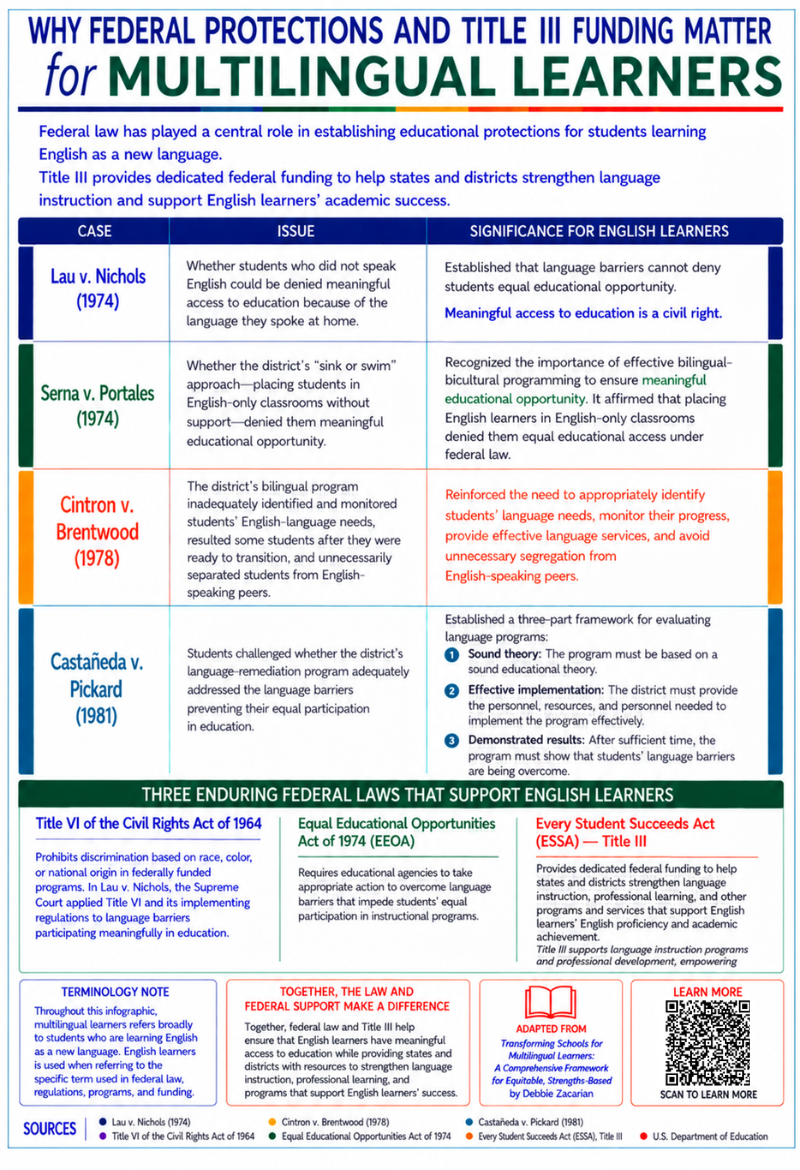
Lau v. Nichols (1974) established that providing students with the same facilities, textbooks, teachers, and curriculum does not constitute equal treatment when students cannot understand English well enough to participate meaningfully in education.
Other cases further shaped how schools identify students’ language needs, provide appropriate services, monitor students’ progress, and evaluate the effectiveness of language programs. Castañeda v. Pickard (1981), for example, established a three-part framework for examining whether programs for English learners are based on sound educational theory, effectively implemented, and successful in overcoming language barriers over time.
The infographic below traces several of these landmark cases and the federal laws that continue to support English learners.
Federal Law and Meaningful Access to Education
Two federal laws are particularly important to understanding schools’ responsibilities to English learners.
Title VI of the Civil Rights Act of 1964 prohibits discrimination based on race, color, or national origin in programs receiving federal financial assistance. In Lau v. Nichols, the Supreme Court applied Title VI and its implementing regulations to language barriers that prevented students from participating meaningfully in education.
The Equal Educational Opportunities Act of 1974 (EEOA) requires educational agencies to take appropriate action to overcome language barriers that impede students’ equal participation in instructional programs.
Together, these protections establish responsibilities that extend beyond providing English learners access to the same classrooms, teachers, and curriculum as their English-proficient peers. Schools must take appropriate steps to ensure that language barriers do not prevent students from participating meaningfully in their education.
What Title III Funding Does
Title III complements these federal protections by providing dedicated federal resources to support English learners.
Through Title III, states and districts can strengthen language-instruction educational programs and provide professional learning and other programs and services designed to help English learners develop English proficiency and achieve academically.
These resources can help schools build the capacity needed to provide effective instruction for multilingual learners. Depending on state and local needs and allowable uses of the funds, Title III can support efforts such as:
- strengthening language-instruction programs;
- providing professional learning for educators who work with English learners;
- developing or enhancing instructional programs and services;
- supporting family and community engagement; and
- expanding opportunities that promote English-language development and academic achievement.
Title III funding does not create schools’ fundamental civil rights obligations. Those responsibilities exist under federal law. Rather, Title III provides additional federal resources intended to strengthen the programs and services that support multilingual learners.
Why This Matters
Multilingual learners attend schools in communities across the United States. Their languages, cultures, educational histories, strengths, and experiences vary considerably, as do the resources available to the schools that serve them.
Federal protections establish a common foundation: English learners must have meaningful access to education, and schools must take appropriate action to address language barriers that interfere with their participation.
Title III provides dedicated resources to help states and districts strengthen the programs, professional learning, and services that support this work.
Together, these federal protections and resources help ensure that multilingual learners have meaningful opportunities to develop English, participate fully in school, and achieve academically.
← Back to Publications & Resources
