

The phrase best practices is used frequently in education. It generally refers to practices that research and experience have shown to be effective. But the term can also suggest that there is a single “best” way to teach—a practice that will work consistently across students, classrooms, and contexts.
Effective teaching is more nuanced.
Research-based practices provide educators with important guidance. Their effectiveness, however, depends on how thoughtfully we adapt them to the students we teach, the experiences and strengths they bring, the learning environment we create, and the goals we are working toward.
In Professional Capital: Transforming Teaching in Every School, educational scholars Andy Hargreaves and Michael Fullan describe best practices as existing practices that have been widely shown to be effective. We have substantial bodies of research identifying practices that support student learning. But does using an established practice in our own classrooms guarantee success?
Consider the following example.
A middle school science teacher designs a unit based on what she wants students to know and be able to do by the end of it. Drawing from her state’s science standards on climate change, the course text, and research-based practices, she develops an overarching question: “Why is the absorption of carbon dioxide important to our planet?” She posts the question on the board, reads it aloud, and asks students to talk with a partner about what they think it means. Their responses reveal that many are unfamiliar with the concept of carbon dioxide absorption. She refers them to the science text, explains the concept, and checks for understanding. When students continue to struggle, she recognizes that they need another pathway into the learning.
Drawing on her knowledge of her students and her teaching experience, she uses photographs, a map, and examples from rainforests to help students explore how plants absorb carbon dioxide and why this process matters to the planet. Students begin making connections to the concept and discussing their ideas with one another. She then invites them to talk with their families about what they know about rainforests and their importance. The following day, students bring those perspectives back to the classroom and use them to extend their learning.
If asked to describe a best practice, this teacher might call it a guidepost—a promising, research-informed practice that she adapts in response to what she learns from her students.
The value of an effective practice lies not in applying it exactly as prescribed, but in using professional knowledge to determine how it can best support the students we teach. This requires knowing our students—their strengths, experiences, cultures, languages, interests, and ways of making meaning—and continually examining how well our instruction is working for them.
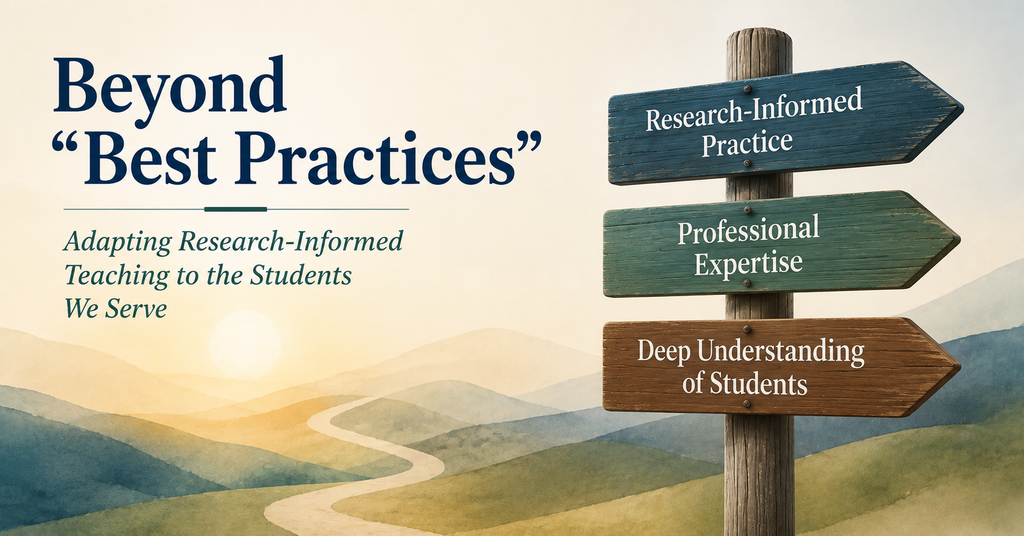
Research can point us toward promising approaches. Our responsibility as educators is to use that evidence thoughtfully and responsively rather than as a one-size-fits-all prescription. Effective teaching occurs when sound research and professional expertise are brought together with a deep understanding of students.
← Back to Publications & Resources
