
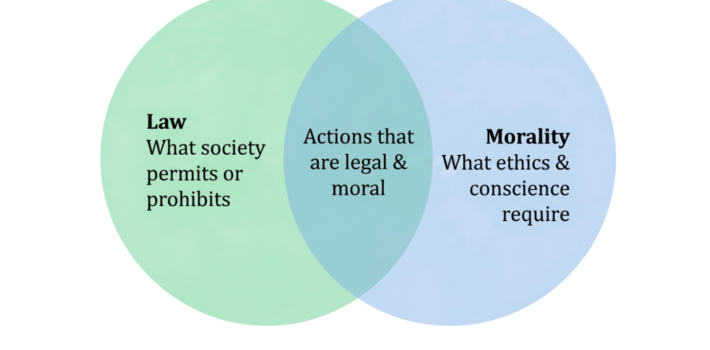

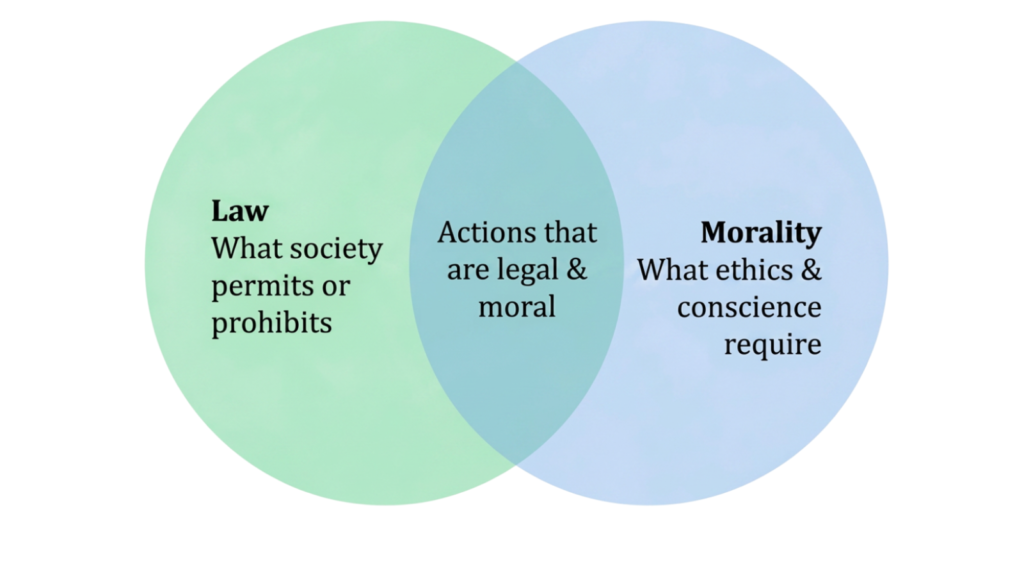
Imagine two overlapping circles. One represents what the law permits or prohibits. The other represents what morality and ethics require. Where the circles overlap, actions are both legal and morally right. The Supreme Court asylum decision reminds us why that distinction matters.
The hardest questions any society faces arise where those circles diverge.
History offers powerful examples.
In 1939, U.S. immigration law allowed the government to deny entry to the passengers of the MS St. Louis. Forced to return to Europe, more than 250 of those passengers later perished in the Holocaust.
During the Civil Rights Movement of the 1960s, sit-ins violated segregation laws. Many protesters were arrested. Yet their moral courage helped change unjust laws and reshape our nation. Were their actions illegal? Yes. Were they right? History has answered that question.
The majority in the Supreme Court’s asylum decision asked the legal question: What does the statute say? Their role, they argued, was to interpret the law enacted by Congress.
Justice Sonia Sotomayor’s dissent raised a moral question: Does the interpretation align with the humanitarian purposes of the asylum laws and the nation’s ideals? In reading aloud her dissent from the bench (a rare act reserved for profound disagreement), she spoke of the MS St. Louis by name. Her reference to the MS St. Louis underscored that legal interpretation does not occur in a historical vacuum. Justice Sotomayor argued that a decision can faithfully apply the law and still fall short of our democracy’s promise.
The Statue of Liberty stands as a symbol of our nation’s highest ideals. Yet throughout our history, there have been moments when our actions have fallen short of these. The enduring work of democracy is to narrow that gap.
History tends to judge societies not only by whether they followed their laws, but also by whether those laws—and the way they were applied—advanced justice, human dignity, and our shared humanity.
This tension is as old as philosophy itself. Aristotle argued that what is legal and what is moral are not always the same thing. Martin Luther King Jr., writing from the Birmingham Jail, reminded us that “An unjust law is no law at all.”
The Supreme Court’s asylum decision will continue to be debated. Only history can answer what this decision will ultimately mean for our democracy.
Every generation inherits two enduring responsibilities: to preserve the rule of law and to examine whether the law continues to reflect our highest ideals.
Democracies flourish best when they continually strive to bring law and morality into closer alignment, making the overlap between them as great as possible.
