
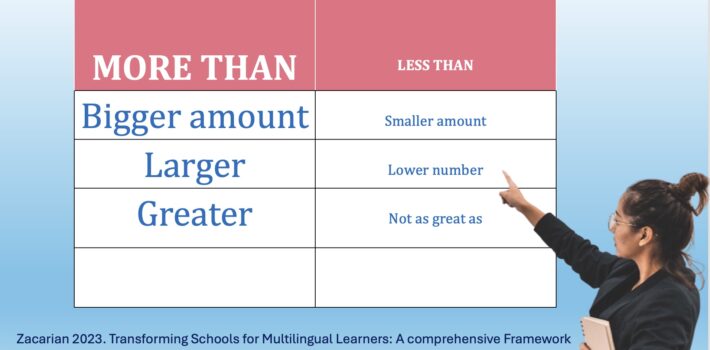

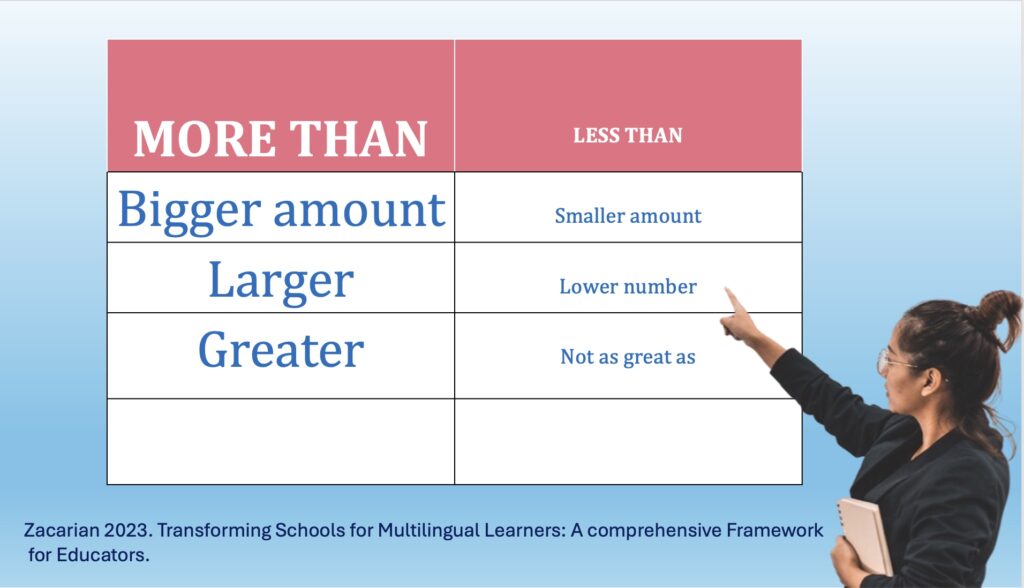
When Mrs. Moyner planned her math lesson, she recalled a colleague’s advice about displaying the vocabulary she wanted students to learn. She knew that English Language and Multilingual Learners (ELs/MLs) benefit from seeing key language in consistent, accessible locations. Using the teacher’s guide for her unit on fractional ratios, she created a list of terms, including ratio, equation, percentage, shrink, and stretch, confident that these would support the lesson. She added them to her word wall and prepared her materials.
When the lesson began, she reviewed each word, asked students to write definitions in their notebooks, and modeled how to solve the first problem. But when she asked whether her solution was “more than” or “less than” the original number, several students, including ELs/MLs and others, did not understand the phrases. She realized the vocabulary she selected did not include the language students actually needed to solve the problem.
Like many teachers, Mrs. Moyner had viewed word walls as lists of isolated vocabulary words. Yet learning academic language is rarely a single-word task. Students must understand and use terms, words, idioms, and phrases (TWIPs) in meaningful context. This requires identifying the complete set of language students need, not only content-specific terms, but also the expressions necessary for thinking, discussing, and fully engaging in a task, as well as participating in their learning communities and lives.
Vocabulary instruction, what I call the teaching of TWIPs, must occur in an intentionally designed environment that provides multiple opportunities for students to use language in meaningful contexts. Random lists of words, whether written alphabetically or in the sequence of a course text, are not intentional enough because they are not embedded in a context that students can readily understand.
To make this more straightforward, consider the guiding question: What are the key terms, words, idioms, phrases, and sentence structures (TWIPs) students need to understand, communicate, and participate in the lesson fully? These represent the language of both the content and the cognitive work required to express the content being studied, as well as the participation structures expected of students.
For example, an imperative such as “Get in your groups” may seem simple but embeds multiple expectations, including moving your desks, gathering materials, facing your partners, and beginning to listen. Many students, including ELs/MLs, may not infer these expectations.
Identifying TWIPs creates a strong foundation for supporting students before, during, and after instruction. The steps below outline how to make this process intentional and instructionally powerful.
Planning Lessons
- Select key TWIPs.
- Design a class activity that introduces TWIPs, allowing students to explore their meanings before encountering them in context.
Pre-Teaching TWIPs
- Identify and display the selected TWIPs.
- Model the pronunciation and use of each TWIP.
- Have students write descriptions, explanations, or examples of each TWIP and illustrate them with a mental map or visual.
During the Lesson
- Reinforce content learning by referring frequently to pre-taught TWIPs.
- Use graphic organizers to scaffold both content learning and language use.
- Integrate instruction across at least two modalities, such as visual and auditory.
Post Lesson
- Select activities that give students multiple opportunities to use TWIPs in meaningful ways such as games, graphic organizers, and sentence prompts.
- Assign homework that requires students to use TWIPs authentically in connection with the day’s learning.
References
Beck, I., McKeown, M. G., and Kucan, L. (2013). Bringing words to life: Robust vocabulary instruction (2nd ed.). Guilford Press.
Pransky, K. (2008). Beneath the surface: The hidden realities of teaching culturally and linguistically diverse learners. Heinemann.
Haynes, J., and Zacarian, D. (2010). Teaching English Learners Across the Content Areas. ASCD.
Zacarian, D. (2013). Mastering Academic Language: A framework for supporting student success. Corwin Press.
Zacarian, D. (2023). Transforming Schools for Multilingual Learners: A comprehensive guide for educators.
Portions of this document are drawn from an earlier work of Zacarian that is no longer available in print. The content has been updated and adapted for this context.
